
Lake County Release Records
A release is the end of one physical custody episode. It is not always the end of a criminal case, sentence, hold, or supervision term. The Lake County Sheriff's Office booking detail is the strongest public starting point for a county-jail event because it can show a Released Date/Time. The same record connects that event to a booking number, inmate number, arrest date, charges, bond information, court case number, and a detainer indicator. When the reason or destination is not clear, the Clerk docket and an LCSO movement record supply the next pieces.
Agency boundaries matter. A transfer from the Lake County Detention Center to the Florida Department of Corrections is continued custody, not release into the community. The same is true of a handoff to another county, federal authority, or immigration authority. Lake Correctional Institution is in Clermont, but it is a state prison. Its release records belong to FDC, not the Sheriff's name search. Juvenile information follows restricted FDJJ and court channels rather than the adult public systems.
A person who leaves the live jail view is not proven released. Confirm the released date, case result, and any receiving agency.
Lake County Release Types
The word “released” can describe several outcomes. Reading the event type before choosing the next search prevents a transfer or supervision placement from being mistaken for a complete discharge. Lake County records may show the physical event while a court, FDC, or receiving agency explains its legal effect.
| Event | What it means | Where to verify next |
|---|---|---|
| Bond or recognizance | The person left jail while the case continued, after all holds cleared. | LCSO released date and Clerk docket |
| Court order or dismissal | A judge or case action supplied authority to end physical jail custody. | Court order plus LCSO processing time |
| Time served | The custodial part of the sentence was completed with lawful credit. | Judgment, jail-credit entries, and booking record |
| Probation or supervision | Physical custody ended while court or corrections control continued. | Clerk docket or FDC supervised-population record |
| State or agency transfer | One custodian handed the person to another. | Movement record and receiving agency |
| Sentence or supervision discharge | The identified prison or supervision obligation ended. | FDC, FCOR, or court discharge document |
Death can also terminate a custody record, but it must never be presented as a routine community release. The source wording and context should be preserved with care.
Lake County Release Fields
There is no single online “Lake County release certificate.” The useful record is a linked set of fields that identifies the person, the custody episode, the date and time of departure, and what followed. Not every public booking contains every field, and a blank field should be checked with Inmate Records.
| Field | What it shows |
|---|---|
| Released Date/Time | When LCSO processed departure from the county booking. |
| Booking and inmate numbers | The identifiers needed to request the correct episode and images. |
| Arrest and booking dates | The beginning of the custody episode. |
| Charge and statute | The allegation tied to that booking, not proof of a final result. |
| Bond amount, type, and status | Bond context, which does not prove that every hold cleared. |
| Case number and court date | The bridge to the Clerk docket and the legal disposition. |
| Detainer indicator | A warning that another authority may have taken custody. |
| Booking photographs | Left, front, and right views when the official detail retains them. |
What proves the reason for release? The jail timestamp proves when LCSO processed the event. A court order, bond record, sentence entry, or movement record explains why it occurred and whether another custodian followed.
Request Lake County Release Records
Start with the official LCSO Inmate Search and save the booking number. Then call Inmate Records at 352-742-4058 to identify the existing release or movement document. Records staff can work more accurately from a specific episode than from an open question about whether someone is “free.” No dedicated release-record form, set LCSO fee schedule, or promised response period was verified in the research.
- Give the person's full name, booking or inmate number, approximate booking dates, and Lake County case number.
- Ask for the booking sheet, release date and time, release type or disposition code, and movement destination.
- Include the detainer disposition, bond-release record, and booking photographs when those items are needed.
- Prefer electronic copies and ask for an itemized estimate before staff incur a stated cost.
- If a field is withheld or redacted, ask the custodian to identify the legal basis.
Florida law allows ordinary copy charges and a reasonable special-service charge when a request demands extensive technology, clerical, or supervisory resources. It does not impose one universal completion time. The LCSO contact directory also lists Records at 352-343-9578 and Media Relations/Public Records at 352-343-9741. The Office of Sheriff is at 360 West Ruby Street in Tavares.
Historical online visibility is not the same as agency retention. LCSO states no fixed period during which a released booking will remain searchable. A no-result page may require a formal request or Clerk search.
Lake County Release Access Laws
Florida Constitution article I, section 24 and chapter 119 support access to state and local records, subject to exemptions. Florida Statutes section 119.07 governs inspection, copying, charges, and the response when an exemption applies. Section 119.071 contains exemptions that can require redaction of criminal-justice or personal information.
Court records follow Florida court rules and administrative orders, not chapter 119 alone. Juvenile, sealed, expunged, victim, medical, security, and protected-person information may be withheld. The Clerk does not expose confidential, sealed, or expunged material through its public search. An empty search is therefore not proof of any one legal event.
Florida's sealing and expunction processes appear in sections 943.059 and 943.0585. They can restrict qualifying official material, but they do not support guessing why a record disappeared. FDC states that sealed or expunged records are removed from its public offender data.
Lake County Release Property Return
The LCSO inmate handbook ties property accounting to departure from the Lake County Detention Center. Issued items must be returned. Damaged or missing issued property may be charged to the inmate account, while stored personal clothing is handled through Booking. These details are useful when a released person finds that clothing, commissary goods, or property did not leave with them.
If release occurs before a commissary order arrives, the order is held for up to ten business days. When a transfer goes to an agency that will not accept the property, pickup must be arranged within 30 days. Approved pickup uses the front lobby from 8 a.m. to 5 p.m., Monday through Friday, excluding holidays, with the Property Release Form. Those are property pickup hours. They are not general jail release hours.
A disputed public field has a parallel correction route. Send LCSO the booking number, the field at issue, the value shown, and a supporting court order. For an FDC error, use the DC number and FDC Central Records.
Note: Booking at 352-742-4024 handles a time-sensitive property issue, while Inmate Records handles the past release or movement record.
Lake County Released Debit Funds
Lake County's handbook provides a specific route for unused Securus inmate-debit funds. A released person can collect the balance through Western Union with the name, inmate-account number, and calling PIN. The handbook says funds are generally available about 15 minutes after release. A balance above $100 may need validation and can take up to 24 business hours.
The claim period is 90 days, and applicable fees or minimums can reduce the amount. This is a communications-account balance. It is not a bond refund, commissary cash, or charge paid to obtain release. Keeping that distinction clear prevents the debit process from being mistaken for an LCSO release fee.
Find Lake County Released Inmates
Classify the last known custody before opening a search. Someone booked at the Lake County jail starts with LCSO. A sentenced state prisoner starts with FDC. A federal prisoner starts with BOP. A possible immigration transfer starts with ICE. Using several systems without first identifying the likely custodian can mix unrelated people who share a name.
- Search the known name in the LCSO system and open each plausible booking.
- Match birth information, booking date, charge, booking number, and case number.
- Read Released Date/Time. Do not infer release from absence, bond status, or an unverified report.
- Copy the case number into the Lake County Clerk search and read the actual disposition or order.
- If state prison or state supervision followed, use the correct FDC search branch.
- Check BOP or ICE only when the custody history supports that path.
- Request the release and movement record when the public fields do not resolve the event.
The evidence has layers. Current agency status answers where the person is now. A jail timestamp answers when physical departure was processed. A court order answers the legal authority. A movement record identifies a receiving custodian. A later discharge order shows when a sentence or supervision obligation ended.
Lake County Offender Search
The FDC Corrections Offender Network menu separates current prison population, prison release, supervised population, and absconder searches. Its scope is felony offenders sentenced to FDC prison or FDC supervision. It excludes people sentenced only to county jail, county probation, or other non-FDC supervision. A Lake County address or arrest does not place a county-only case in the state database.
| FDC route | Use it for | Key fields |
|---|---|---|
| Population search | A person still in Florida state prison | Name, six-character DC number, location, sentence data, current release date |
| Inmate Release Search | A completed or scheduled FDC prison release | Release Date, Date Out-Custody, identity and prison history |
| Supervised Population | Active FDC community supervision | Type, status, office, location, dates, offenses |
| Absconder/Fugitive | An alleged failure to remain in contact | Official supervision status, not proof of current jail custody |
The main form accepts last name, first name, and a six-character DC number, with alias and photo filters. Name results begin with the entered text. FDC warns that location, status, and release information can change quickly, so a source record or office call should resolve a material conflict.
The official search menu shows why the branch matters.
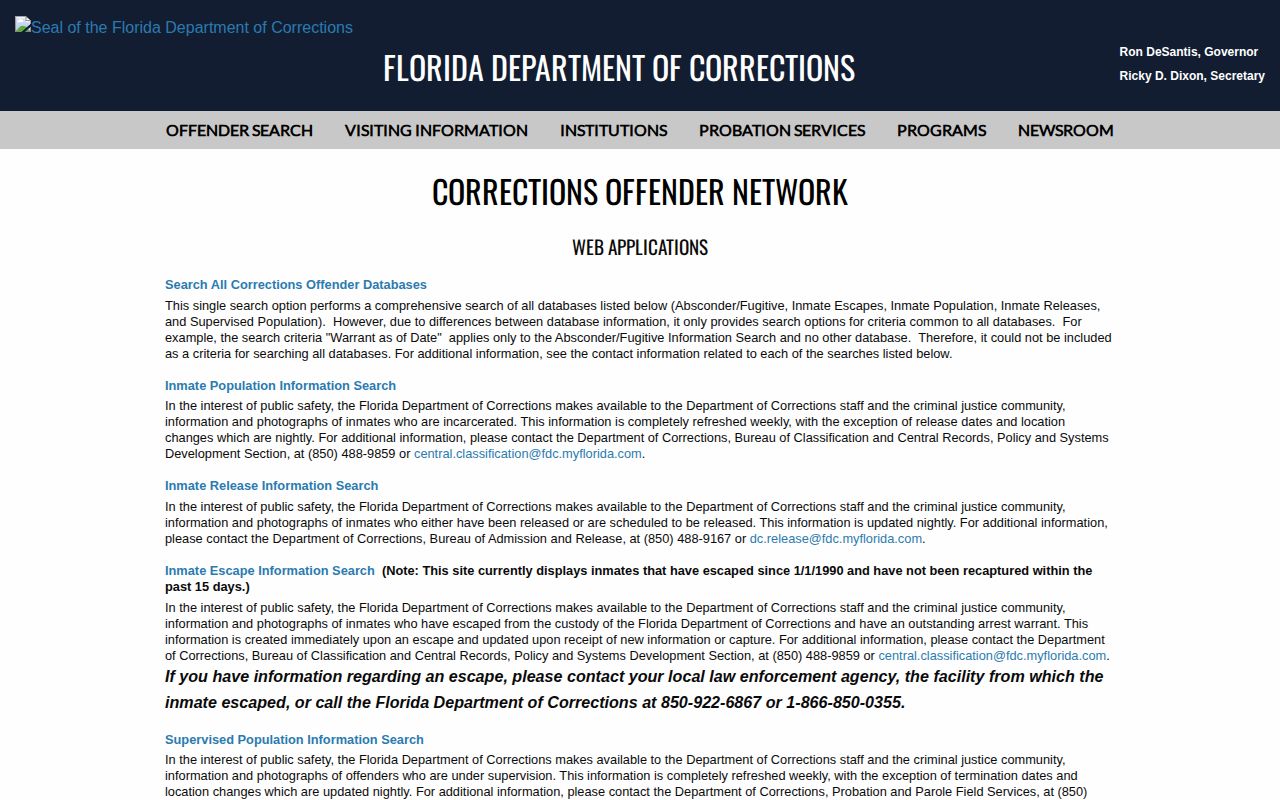
A county-jail release will not appear here unless the person also entered FDC custody or supervision.
Lake County Recent Releases
LCSO does not publish a browseable list of everyone released in the last 24 or 72 hours. Its official interface is name-only, uses a CAPTCHA, and has no public release-date filter. A known person's booking detail may still contain the released date, photos, bond details, detainer status, and case number. No public refresh interval or online retention promise was verified.
For an event still being processed, call Jail and Inmate Information at 352-742-4000 or Booking at 352-742-4024. For a precise daily or three-day set, ask whether an existing release report or database extract can be provided between exact start and end times. Public-record law does not require LCSO to create a report that does not exist.
Is the Sheriff's app a release feed? No. The official app documents Inmate Info, Recent Arrests, Most Wanted, and News, but not Recent Releases. Arrests and releases are different events.
Lake County Court Release Proof
The LCSO charge block exposes a Lake County case number, which makes the booking and court systems unusually easy to join. Search that number at the Lake County Clerk court-record portal. The docket may contain bond orders, release on recognizance, dismissal, sentence, jail credit, probation, revocation, modification, and discharge. A “closed” label alone is not a release type.
Online criminal felony and misdemeanor docket coverage begins January 1, 1989, subject to access limits. When an online image is not available, the Clerk's manual search costs $2 per calendar year per name, plus $1 for fax delivery. The stated response period is seven to ten business days after payment. Those are Clerk search terms, not LCSO release-record fees.
The court supplies the legal disposition, while LCSO supplies the physical release time. Read both when the precise event matters.
Lake County Release Supervision
Physical release does not always end correctional control. Probation is usually imposed by a court. FDC administers state supervision when the sentence falls within its system. Parole is a discretionary form of release managed by the Florida Commission on Offender Review, but ordinary Florida parole generally applies only to older or specially eligible sentence structures. Conditional release is a separate post-prison program for defined categories.
Search the FDC Supervised Population branch by name or DC number, match the identity and offense, then record the supervision type, status, office, and dates exactly as shown. County probation, pretrial release, federal supervised release, and juvenile supervision are different systems. The Lake County parole and probation resource explains the correct verification chain.
- Parole
- Discretionary supervised release available within a limited eligible Florida population.
- Probation
- A court-ordered community sentence that may occur without a prison release.
- Discharge
- The documented end of a prison term or supervision obligation.
- Absconder
- A person alleged to have stopped reporting to the supervising agency.
Lake County Release Notifications
VINELink provides custody information and event alerts from participating agencies. Select Florida, search a specific person, match the agency and identity, then read the status phrase exactly. A released or out-of-custody result should still be confirmed through LCSO or FDC because VINE receives agency data and can lag. General users register through the options on the matched VINELink record. FDC's separate statutory victim form is not a general family-and-friends signup.
Federal prison custody belongs in the BOP Inmate Locator. A BOP release date does not rule out later state, county, immigration, or supervised-release obligations. The ICE locator can help when immigration custody is genuinely possible, but a missing result may reflect timing, age, scope, transfer, removal, or release. The U.S. Marshals Service can use local or contracted detention for federal pretrial custody, so a jail departure on a federal hold may be a transfer.
Lake County Custody Systems
Released and still-in-custody records are not interchangeable. Use the system that owns the custody episode, then confirm whether the displayed event means community release or a handoff.
| Situation | Official first source | What confirms release |
|---|---|---|
| Lake County jail booking | LCSO name search | Released Date/Time plus record or court context |
| Florida state prison | FDC population or release search | Release Date and Date Out-Custody |
| FDC supervision | Supervised Population Search | Status, dates, and discharge document |
| Federal prison | BOP locator | Federal release wording and date |
| Immigration custody | ICE locator and ERO | Agency confirmation within locator limits |
| Lake County court case | Clerk docket | Actual order, disposition, or termination entry |
Note: A transfer date, a paid bond on one charge, or disappearance from a roster does not by itself prove community release.
Lake County Release Facilities
The four mapped facilities require three distinct record paths. Adult county bookings use LCSO. State-prison records use FDC. Juvenile records remain restricted.
- Lake County Detention Center: the primary county jail, with release confirmed through the LCSO booking, Clerk docket, and Inmate Records.
- South Lake District Intake Facility: an LCSO intake component, not a separate public release archive.
- Lake Correctional Institution: an FDC state prison whose releases remain in statewide corrections records.
- Marion Regional Juvenile Detention Center: a regional youth facility requiring authorized FDJJ and juvenile-court channels.
The Lake County Judicial Center has temporary court holding cells, but people are transported to and from the county jail. Those cells do not form a separate public release archive.
Getting Home After Lake Release
LakeXpress Route 1 has a timed Main Street/Lake County Judicial Center stop by the downtown jail and court complex. The fixed-route service operates Monday through Friday. It does not run on Saturdays, Sundays, or federal holidays, so a late, weekend, or holiday release requires another ride.
The jail does not promise transportation, a routine release time, or a named exit. A pickup plan should therefore wait for direct confirmation that release processing is complete. The route can help after a weekday departure, but it should not be treated as guaranteed transport from custody.
Bonding Out in Lake County
LCSO publishes two bond routes: use a bonding agency or bring the full bond to the Detention Center lobby. Full bond may be paid in cash, cashier's or certified check, or money order. For local charges, the payment instrument is made to the Clerk of Courts. For out-of-county charges, it is made to the Lake County Sheriff. An inmate may also use commissary funds to post a personal bond.
Another charge or hold can prevent departure even when one bond has been handled. Verify the amount, payee, and current processing status with Booking at 352-742-4024. The official booking detail's Released Date/Time remains the public field that shows when the jail processed departure.