
Lake County Projected Versus Actual Release
A projected date is an administrative estimate based on a sentence, lawful credit, and the release rules that apply to the person. Florida law calls FDC's state-prison computation the tentative release date, or TRD. The public offender detail may use the label Current Release Date. Neither label guarantees the exact gate event. A later award, forfeiture, court order, detainer, or sentence change can alter the result.
The actual release is the movement that occurred. In the Lake County jail record, that event can appear as Released Date/Time. An FDC release detail can show Release Date and Date Out-Custody. Those fields answer a past-event question. A future projection instead answers what the responsible agency now expects, subject to change.
A pretrial detainee usually has no sentence-based projection. Release may depend on bond, release on recognizance, a prosecutor's action, or a court order. A date calculated for a sentenced person should never be copied onto a pretrial booking simply because both people are held at the same jail.
Find a Lake County Projected Release Date
Start by deciding who owns the calculation. The Lake County Detention Center is a county jail. Lake Correctional Institution is an FDC state prison. A person sentenced only to county jail will not gain a state-prison TRD merely because the arrest occurred in Lake County. Conversely, a state prisoner's date belongs in FDC, even if the prison or home address is local.
- Use the booking and court case to identify whether the person is pretrial, serving a county sentence, or committed to FDC.
- For FDC custody, search the Corrections Offender Network by name or DC number and open Inmate Population Information.
- Record the Current Release Date, sentence fields, offense history, and custody status exactly as displayed.
- For a county sentence, call LCSO Inmate Records at 352-742-4058 and compare the jail calculation with the Lake County judgment and jail-credit entry.
- For a pretrial case, check the Clerk docket for bond, first-appearance, pretrial-release, dismissal, or later custody orders instead of asking for a TRD.
Use identifiers to avoid a false match. FDC accepts a six-character DC number and name fields, while LCSO booking and court records expose a booking number and case number. The full Lake County release-record route shows how those local identifiers connect.
The official FDC inmate-population result below illustrates where the state system presents its Current Release Date field.
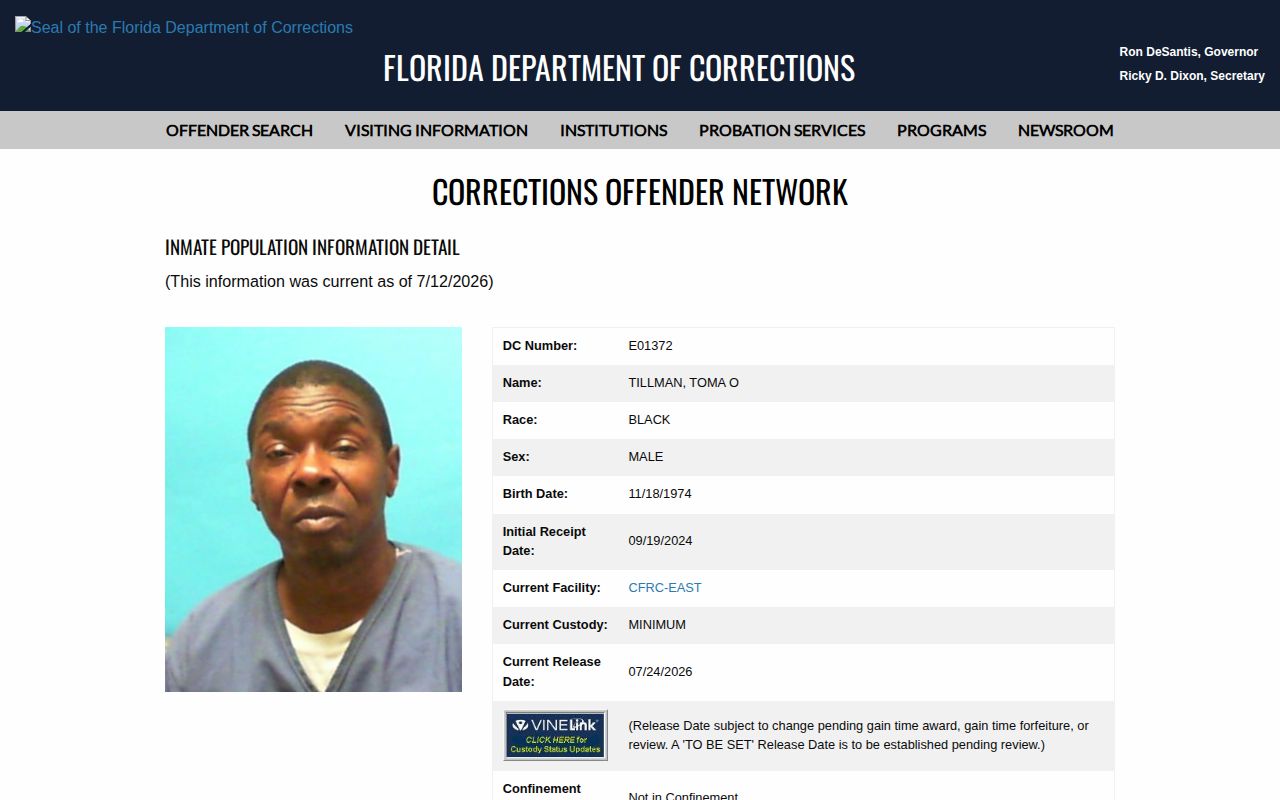
That state field does not calculate the release date for a person serving only a Lake County jail sentence.
Florida State-Prison Release Date Math
FDC first derives maximum sentence expiration from the court-imposed term and lawful credit for time already spent in jail or prison. It then deducts gain time that the person is eligible to earn, creating the tentative release date. Later awards or restored gain time can move the TRD earlier. A forfeiture can move it later. The projection cannot extend beyond the maximum expiration date.
For eligible offenses committed on or after October 1, 1995, Florida Statutes section 944.275 permits up to ten days per month of incentive gain time. The same law prevents gain time from producing release before service of 85 percent of the sentence imposed. Court-awarded credit for time physically incarcerated counts toward that floor.
The 85 percent figure is a minimum service rule, not a promise that every eligible person leaves at that point. Mandatory minimum terms, consecutive sentences, ineligible offenses, disciplinary action, detainers, and later court orders may keep the date later. Older basic-gain-time provisions also apply only to specified older offense periods. A reliable case calculation therefore comes from FDC and the sentencing record, not a simple percentage typed into a date calculator.
Lake County Jail Gain-Time Rules
Lake County Code section 9-3 creates the local layer that a state-prison formula cannot supply. It identifies statutory, work, constructive, and extra gain-time categories for county prisoners, along with forfeiture rules. The statutory tiers track the statewide county-prisoner framework: up to five days per month in the first and second years, ten days in the third and fourth years, and fifteen days in the fifth and later years, when the credit is earned and allowed.
Local limits matter. Sustained discipline or a violation of state law can make a county prisoner ineligible for that month. A mandatory portion can block an award. Work gain time requires satisfactory recognized work and no infractions, while work-release and community drug-treatment participants are ineligible for that work-credit category. The jail handbook says a recommendation to restore forfeited gain time is reviewed no sooner than 90 days and considers later conduct, work, and interactions.
This is the distinctive reason a Lake County jail projection may move even when the sentence itself has not changed. Section 951.21 gives county good-conduct authority, but the judgment, jail-credit calculation, and current local policy determine the case result. No current Lake County resolution changing the statutory policy was verified. Do not calculate a personal date from the tiers alone.
Section 951.21 says county commissioners shall grant the listed commutation unless the board elects by majority vote to discontinue or revise that policy. The credit depends on good conduct and can be forfeited. Section 921.161 separately addresses when a sentence begins and credit for county-jail time served before sentencing. These laws answer different parts of the equation. The sentencing order establishes the term and court-awarded credit; the jail applies the valid county gain-time policy; the final movement record establishes what took place. Inmate Records should confirm the active calculation rather than asking a family member to combine statutory excerpts.
Why Lake County Release Dates Change
A displayed date is a snapshot of known facts. Courts can correct credit or change a sentence. FDC and LCSO can award, restore, or forfeit lawful credit. Another authority may place a hold that changes where the person goes on the nominal release day. In a parole-eligible case, FCOR may act on a separate presumptive or effective parole date.
| Change | Likely effect | Best confirmation |
|---|---|---|
| Court awards jail credit or corrects sentence | Earlier or recalculated expiration and projection | Signed sentencing order and agency calculation |
| Eligible gain time is awarded or restored | Projection may move earlier within legal limits | FDC or LCSO calculation record |
| Gain time is forfeited | Date may move later | Disciplinary and release-calculation records |
| New or consecutive sentence | Maximum term may extend | Court judgment and FDC record |
| Detainer or another hold | Handoff may replace community release | Movement record and receiving agency |
| FCOR action in an eligible parole case | Effective date may be set or delayed | FCOR written order |
A detainer does not always change the sentence calculation itself. It can instead change the destination at release. The nominal date may arrive while the person moves to another county, state, federal, or immigration authority.
Lake County Parole Release Milestones
An older parole-eligible Florida sentence can carry dates that should not be confused with a TRD. A presumptive parole release date, or PPRD, is developed through the parole process under sections 947.16 and 947.172. An effective parole release date, or EPRD, is a later milestone addressed under section 947.1745. FCOR may delay the effective event when a release plan is unsatisfactory.
Maximum sentence expiration, TRD, PPRD, and EPRD each answer a different question. Record the exact label and agency. For a scheduled FCOR matter, an agenda proves only that review was set. The final written order proves what the Commission decided.
Lake County Release Date Terms
Similar labels can describe different steps. Keep the agency's own words when saving a result or asking for a correction. A person may have a maximum sentence expiration, a gain-time projection, a parole milestone, an out-custody date, and a supervision end date in the same overall case. Those dates do not conflict merely because they differ.
- Maximum sentence expiration
- The endpoint derived from the imposed sentence and lawful credit before eligible gain time changes the projected exit.
- Tentative release date
- FDC's statutory name for a state-prison projection produced through gain-time rules.
- Current Release Date
- The user-facing label on an FDC inmate-population detail. It is still subject to lawful recalculation.
- Date Out-Custody
- An FDC released-person field recording a past state custody event rather than a future estimate.
- Released Date/Time
- The Lake County Sheriff's booking-detail field for a county movement or release event.
- Termination date
- A supervision milestone that may occur well after release from jail or prison.
When two sources differ, compare their scope before assuming error. The Clerk records the court's sentence and later orders. FDC computes state-prison dates. LCSO maintains the county booking and movement record. FCOR controls parole decisions for eligible cases. Each office can correct only the record it owns.
Confirm Lake County Actual Release Dates
Recheck the source near the expected date. For a state prisoner, compare the FDC population record with the later Inmate Release Information Search. The released detail can show Release Date and Date Out-Custody, along with sentence and incarceration history. For the county jail, use the LCSO booking detail and ask Inmate Records for the release or movement entry when the online field is absent or unclear.
Lake County Release Confirmation
Lake County Detention Center: 551 West Main Street, Tavares, FL 32778
Jail information: 352-742-4000
Inmate Records: 352-742-4058
State cases: Use the FDC offender record and the contact route shown for that DC number.
VINELink can provide a custody-change alert for participating agencies, but it is not the archive of record and can lag. Confirm the alert with LCSO or FDC. The Lake County VINELink check gives the separate registration steps and limits.
The FDC release example below shows the state system's distinct past-release fields. It should not be used as proof of a Lake County jail event.
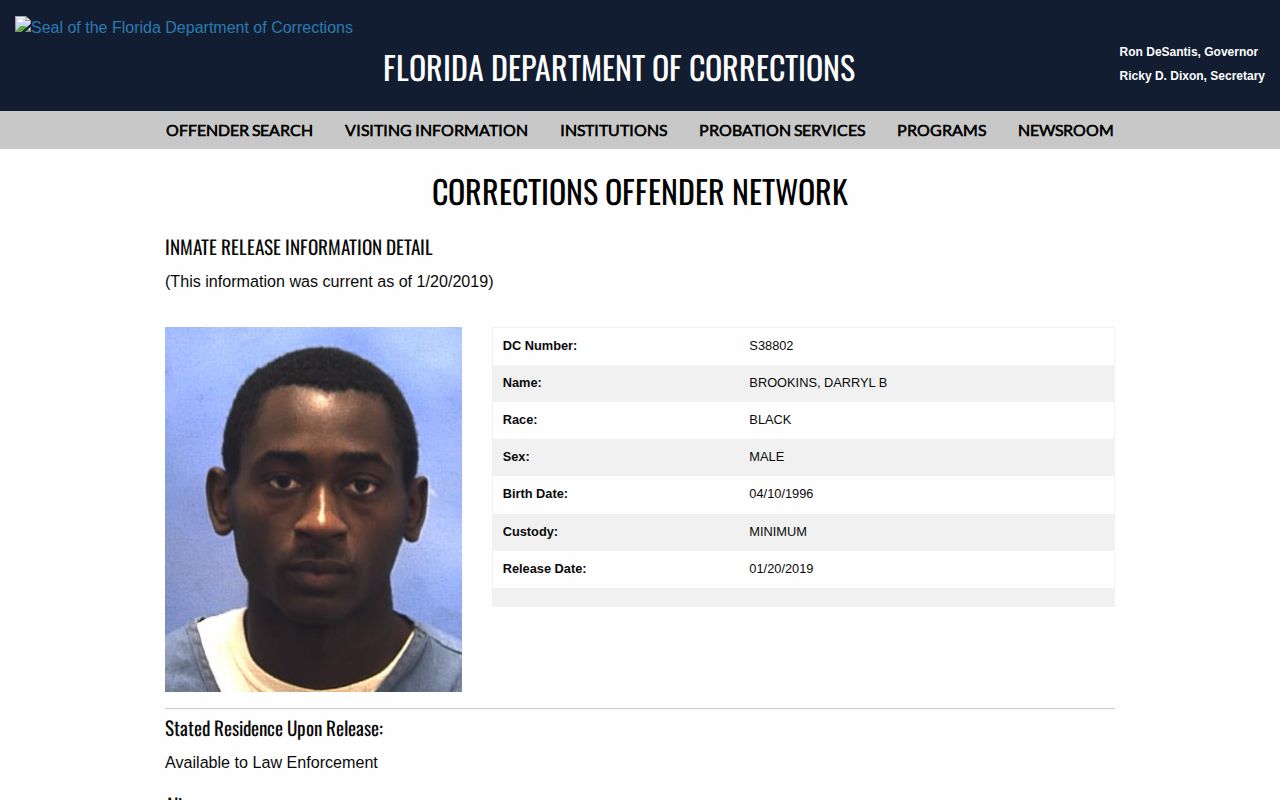
Save the final official wording and date, then compare it with any supervision entry because prison release and supervision discharge can occur years apart.