
Marion Regional Juvenile Detention Center Records
The Florida Department of Juvenile Justice facility page identifies Marion Regional Juvenile Detention Center as a 60-bed, hardware-secure center. It serves Marion, Citrus, Hernando, Lake, and Sumter counties. Youth may be held while awaiting adjudication, disposition, or placement. Adjudication is the juvenile court's decision on the allegations, while disposition is the court's order about what follows.
Its Ocala location explains why a Lake County youth can be held outside Lake County. The regional service area does not turn the facility into an adult county jail. LCSO's public inmate search and FDC's adult state offender search are not release locators for youth at this center. The responsible systems are FDJJ and the juvenile court, subject to strict access limits.
Marion Regional Juvenile Detention Center Releases
An authorized release can return a youth to a parent or guardian under conditions set by the court. A youth may instead move to another juvenile placement or program. That transfer is not community release. The exact outcome depends on the court order, FDJJ case record, and placement status. No public adult booking page can establish which event occurred.
The key records also answer different questions. A court order establishes the legal action. FDJJ or facility staff can address actual detention status and the custody transition for a person who is entitled to receive that information. Counsel can interpret an order and communicate through the case. A parent or legal guardian may need to verify identity and authority before protected information is discussed.
Do not interpret silence from a public search as proof of release. Youth are outside those adult databases by design. A restricted record can exist even when no name appears on the web. Likewise, an authorized transfer can end detention at Marion Regional without returning the youth home.
Marion Regional Juvenile Detention Center Release Contact
The FDJJ facility page supplies the center's address and phone. That contact can route an authorized status question, but the person answering must still apply confidentiality rules. Prepare the youth's name and known case information, the requester's relationship, and proof of authority. Avoid sending sensitive facts through an unverified channel.
Marion Regional Juvenile Detention Center
3040 NW 10th Street
Ocala, FL 34475
Facility telephone: 352-732-1450
Serves Marion, Citrus, Hernando, Lake, and Sumter counties. Public information hours were not stated in the reviewed source.
The facility phone is not a general public lookup service. Its usefulness depends on authorization. A parent, guardian, youth, or counsel should explain the relationship and ask what proof is needed. If the issue concerns a court order rather than physical location, contact the juvenile court or counsel. If it concerns placement after detention, the responsible FDJJ channel is the better source.
The official FDJJ facility page shown below confirms the center's identity and regional role. It is not a screenshot of any youth record.
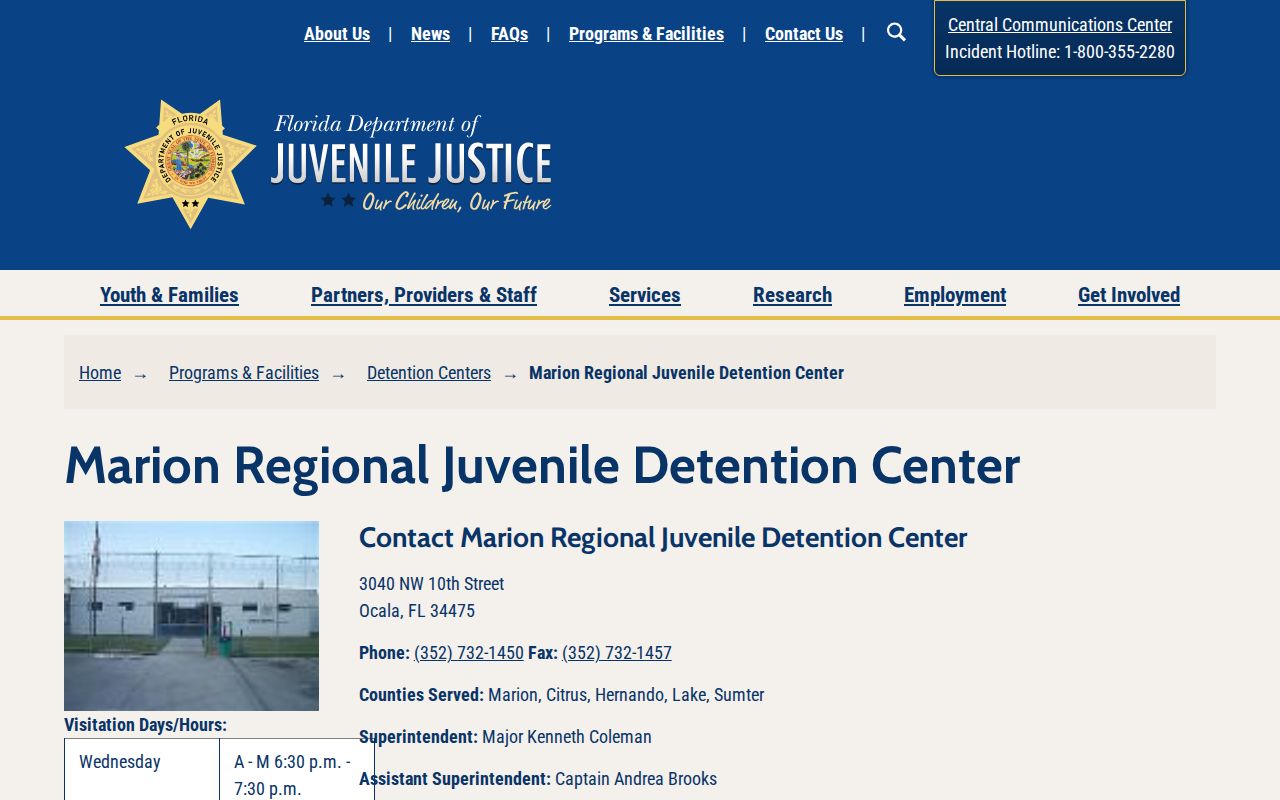
The source supports facility contact and service-area facts while preserving the required boundary around individual juvenile information.
Marion Regional Juvenile Detention Center Release Records
The court record may explain whether a youth was released to a guardian, placed under conditions, or moved to another juvenile setting. Public adult criminal docket coverage should not be substituted for the protected juvenile file. The Lake County Clerk records-search instructions expressly limit juvenile access and call for photo identification for the youth searched or legal guardian.
The Clerk's Court Data and Records Division can identify the proper Lake County record channel. A court case can contain hearings, orders, adjudication, disposition, placement, or later modifications. Access to a docket or document does not erase the confidentiality rule. Ask which office holds the juvenile file and what proof is required. Counsel may already have the relevant order and can often explain what it permits.
| Question | Authorized source |
|---|---|
| Is the youth physically at the center? | Facility or assigned FDJJ contact, after authority is verified |
| What did the judge order? | Juvenile court record or counsel |
| Did the youth move to another placement? | FDJJ case or placement channel for an authorized requester |
| What proof is needed for access? | The office holding the record |
These sources should be reconciled. The court explains the legal action, while FDJJ confirms the custody or placement step within what the requester is allowed to know. Neither is replaced by an adult public inmate database.
Marion Regional Juvenile Detention Center Search Limits
The LCSO Inmate Search concerns Lake County adult bookings and has no authority to disclose a Marion Regional juvenile record. The FDC Corrections Offender Network concerns felony offenders sentenced to adult state prison or state supervision. It also is not the right place to look for a youth held pending juvenile adjudication, disposition, or placement.
VINELink coverage depends on participating agency data and should not be assumed for an individual youth. BOP and ICE tools address federal or immigration custody, not this state juvenile detention center. A missing result in any of those systems says nothing reliable about release from Marion Regional. The system mismatch is the issue, not a lack of records.
- Detention
- Secure temporary custody while a juvenile matter moves through court or placement decisions.
- Adjudication
- The juvenile court's decision on the allegations.
- Disposition
- The juvenile court order that sets what happens after adjudication.
- Placement
- A juvenile setting or program that may follow detention and is not necessarily community release.
For general adult release research in the county, the Lake County released inmate search explains LCSO and FDC sources. It should not be applied to this juvenile facility or used to bypass protected channels.
Marion Regional Juvenile Detention Center Records
A request should go to the office that created or holds the specific juvenile record. State the requester's relationship and authority first. Identify the youth and case only through a secure method approved by that office. Ask for the known court order, detention-status record, or placement notice rather than a broad public file search.
Possible responses include access after identity review, referral to counsel or another office, a redacted record, or denial because the requester lacks authority. Do not treat a denial as evidence about the youth's location. It is an access decision. The correct next step is to ask what lawful proof, court process, or representative is needed.
A focused authorized request may include:
- The requester's name and relationship to the youth
- Proof of identity and guardianship or other authority
- The known juvenile case or referral number
- The date and type of custody event at issue
- The specific order, status, or placement record sought
Keep the resulting information private and use it only within the lawful purpose for which access was granted. Public posting can harm the youth and conflict with confidentiality rules. This facility page therefore names official channels and contact facts without reproducing a roster, individual result, or youth image.
Note: The page intentionally provides no public youth search, example identity, or workaround around the authorized juvenile records process.
Marion Regional Juvenile Detention Center Release Paths
A return to a parent or guardian can be a community release subject to court terms. A move to another secure or nonsecure juvenile placement is a transfer. Both events end the stay at Marion Regional, but only one returns the youth to the guardian at that point. Ask for the exact event and destination rather than the vague question of whether the youth left.
This distinction is the juvenile counterpart to the adult custody rule, but the proof is not public. FDJJ and the court maintain the authoritative facts. An authorized requester should preserve the exact wording, date, and source of the answer. If the facility and court information appear to conflict, counsel can reconcile the physical placement with the order.
The safest path is narrow: verify authority, contact the facility or assigned FDJJ channel, obtain the applicable court information, and respect all disclosure limits. That process protects the youth while still allowing a parent, guardian, youth, or counsel to resolve a genuine custody question.