
Lake County 72-Hour Release Route
No separate Lake County Sheriff's Office URL presents all people released during a rolling 72-hour period. The LCSO Inmate Search is name-based and has no public date-range filter. When a known person's booking remains available, its detail can show Released Date/Time, booking and inmate numbers, arrest and booking dates, arrest agency, charges, court data, bond status, detainer status, and booking photographs.
That route answers a specific-person question. It cannot show whether the returned names form a complete three-day set. LCSO also publishes no numeric refresh interval and no fixed period for keeping released bookings online. For a full interval, ask whether the agency holds an existing daily-release report or database extract and define the start and end date-times. The wider request can bridge days when office access or transportation is limited without claiming that the jail delays weekend processing.
The following image comes from the official LCSO name search and released-booking source, the verified online fallback for a known person.
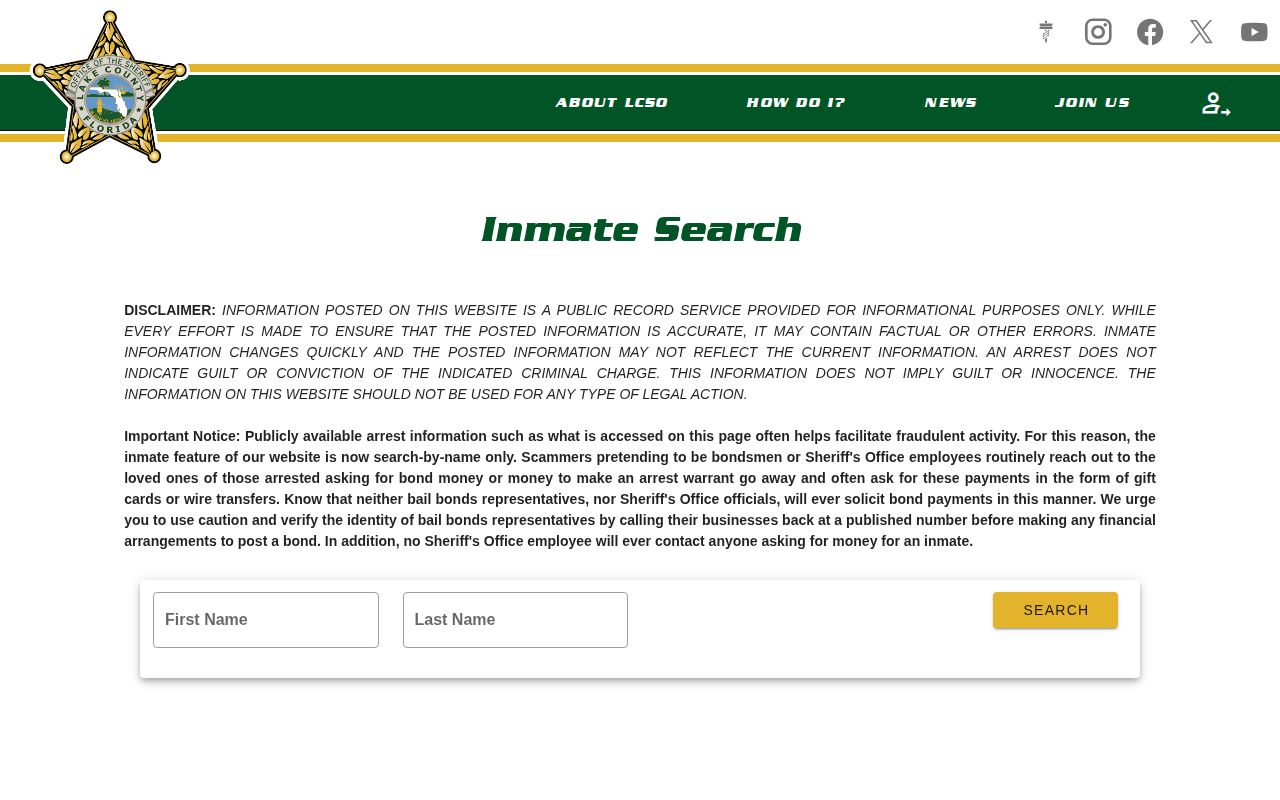
Its named-person design shows why a complete rolling three-day list cannot be browsed or filtered on the public interface.
Check Lake County Three-Day Releases
Start by deciding whether the task is to verify one person or obtain every recorded departure in an interval. A named-person search is faster. A complete period requires records staff because the public page cannot sort by release time. The Lake County released inmate lookup adds court, state, and federal paths when the last custodian is not clear.
- Set exact start and end date-times for the 72-hour period, including the time zone if the request could be misunderstood.
- For one known person, search the LCSO page and complete its CAPTCHA.
- Open each plausible booking and match the booking date, charge, case number, and other identifiers.
- Read Released Date/Time. Do not infer release from bond status or a missing active result.
- Call Jail and Inmate Information at 352-742-4000 for a current status question or Inmate Records at 352-742-4058 for historical confirmation.
- For the full set, request the existing report or extract covering the exact three-day window and name the needed fields.
Public-record law provides access to existing nonexempt records. It does not require LCSO to create a new custom report. Asking first whether the jail system already produces a daily-release report can narrow the work. If records staff identify fees or redactions, request a cost estimate and accept lawful limits rather than assuming every internal field is public.
Note: A 72-hour boundary should use exact timestamps because “three days” can otherwise describe different calendar and rolling periods.
Lake County 72-Hour Release Fields
The Sheriff's public detail and the research inventory support a focused field request. Some values are visible on the named booking, while release type, transfer destination, or detainer disposition may require records staff. Ask only for fields kept in existing records.
| Requested field | Purpose in the three-day set |
|---|---|
| Full name | Identifies the person attached to the custody event. |
| Booking or inmate number | Separates one custody episode from another. |
| Booking date-time | Places the release within the correct local episode. |
| Release date-time | Tests whether the event falls inside the requested window. |
| Release type or disposition code | Provides the recorded event description when maintained. |
| Receiving agency or destination | Distinguishes community departure from transfer. |
| Detainer and bond status | Adds context without independently proving release. |
| Charge and case number | Connects the event to the court docket. |
A court order and jail timestamp answer different questions. The order can explain the legal basis, such as bond, dismissal, sentence, time served, probation, or transfer. LCSO documents when physical jail processing ended. If the release type is blank, search the Lake County Clerk docket by the booking detail's case number and request the movement or release record from Inmate Records.
Lake County Weekend Release Windows
A three-day interval is useful when a release may have occurred from Friday through Sunday, across a federal holiday, or before someone could contact an office. It reduces the chance that an uncertain date pushes the event outside a narrow daily request. Still, no official source says Lake County holds weekend releases for a weekday. The wider interval is a records-search choice, not a statement about jail practice.
The downtown Tavares location adds a practical concern. LakeXpress fixed-route service runs Monday through Friday, not Saturdays, Sundays, or federal holidays. A person leaving the Lake County Detention Center during a no-service period may need another ride. LCSO promises neither transportation nor a set gate time. Verify the release before arranging pickup, since a court order or bond payment can precede final jail processing.
A 72-hour search also should not collapse distinct events. A transfer to FDC or another authority ends the Lake County jail episode but is not a community release. A detainer can lead to another custodian. The records request should keep the receiving agency and detainer disposition in view so the broader set remains accurate.
Lake County Release Archive Differences
Lake County's name-only interface may expose old released bookings, yet it gives no retention promise. It has no downloadable three-day file, release-date control, or published archive depth. A historical name test can be useful, but an empty result cannot prove the record was erased, sealed, expunged, or never existed. Formal LCSO records and the Lake County court docket are the sound fallback.
Florida Department of Corrections data has a different design. The FDC Inmate Release Search concerns people released from state prison, updates nightly, and includes a released OBIS cohort dating from October 1, 1997. It is much deeper than the county public interface, but it excludes county-only jail sentences and county probation. It cannot be filtered into a Lake County jail 72-hour feed.
| Source | What it covers | Three-day limitation |
|---|---|---|
| LCSO name search | Known Lake County bookings and a possible release timestamp. | No browseable period or date filter. |
| LCSO records request | Existing county release or movement reports. | Availability depends on records kept and lawful redactions. |
| FDC release search | Florida state-prison release records. | Not a county jail list. |
| Clerk docket | Legal disposition and court orders. | Does not replace the physical jail departure time. |
This archive contrast is the distinctive Lake County answer to a missing three-day view: use the local booking for one named person, a bounded LCSO report for the whole window, and FDC only when state-prison custody is part of the person's history.
Lake County Release Custody Checks
A person who remains in the live jail population has not completed the local release event. Someone with Released Date/Time has left that Lake County booking, but the next destination still matters. Bond or a court order may lead to the community. A state sentence may lead to FDC. A hold may lead to another county, federal, or immigration custody.
- Release
- The end of a particular custody episode, which may be to the community or another legal status.
- Transfer
- Movement from one custodian to another rather than freedom from all custody.
- Detainer
- A hold or request from another authority that may act when local custody ends.
- Discharge
- The end of a sentence or supervision obligation, not merely leaving the county jail.
Use the source tied to the next stage. FDC's inmate population and release searches cover a state-prison transfer or discharge. The Federal Bureau of Prisons locator covers a federal prison term. The Clerk docket explains the court basis. VINELink can provide agency-fed change alerts, but it is not a permanent archive and can lag.
Lake County Daily Release Comparison
The 24-hour and 72-hour paths use the same official sources because LCSO supplies neither public feed. Their intent differs. A same-day check narrows attention to a recent event and is often paired with a status call. A three-day request widens the date boundary for weekends, holidays, or an uncertain departure day. Neither should be described as an online roster that Lake County does not publish.
For today's narrower interval, use the Lake County 24-hour release process. For the wider three-day interval, keep each exact timestamp and ask for an existing report. In both cases, match names with a booking number, case number, date, or other identifier. Common names and repeat bookings make a one-field match weak.
Note: The Sheriff's app lists Inmate Info and Recent Arrests, but no documented Recent Releases feature supplies either time window.
Request Lake County Release Records
When the public booking search cannot answer the question, use the official LCSO contact directory for Inmate Records and describe the record, not a broad conclusion staff must research. State the precise interval and ask for the existing daily-release report, release log, or database extract if one exists. Include the field list that matters, and request a cost estimate before copies are produced. LCSO publishes no dedicated release-record form, fee schedule, or promised turnaround.
For one person, give the full name, booking number if known, approximate booking date, and case number. Ask for the booking sheet, release date and time, release type or disposition code, movement destination, detainer disposition, and bond-release material. If a public field appears wrong, name the disputed field and displayed value and attach the supporting court order.
The Lake County Clerk is a separate custodian. Its court record can confirm the legal order but not the precise moment LCSO completed departure. Using both sources preserves the distinction between legal authority and physical release, which is especially important when a three-day span contains bond activity, court action, and a later jail timestamp.
Public Record Search
Sponsored Results